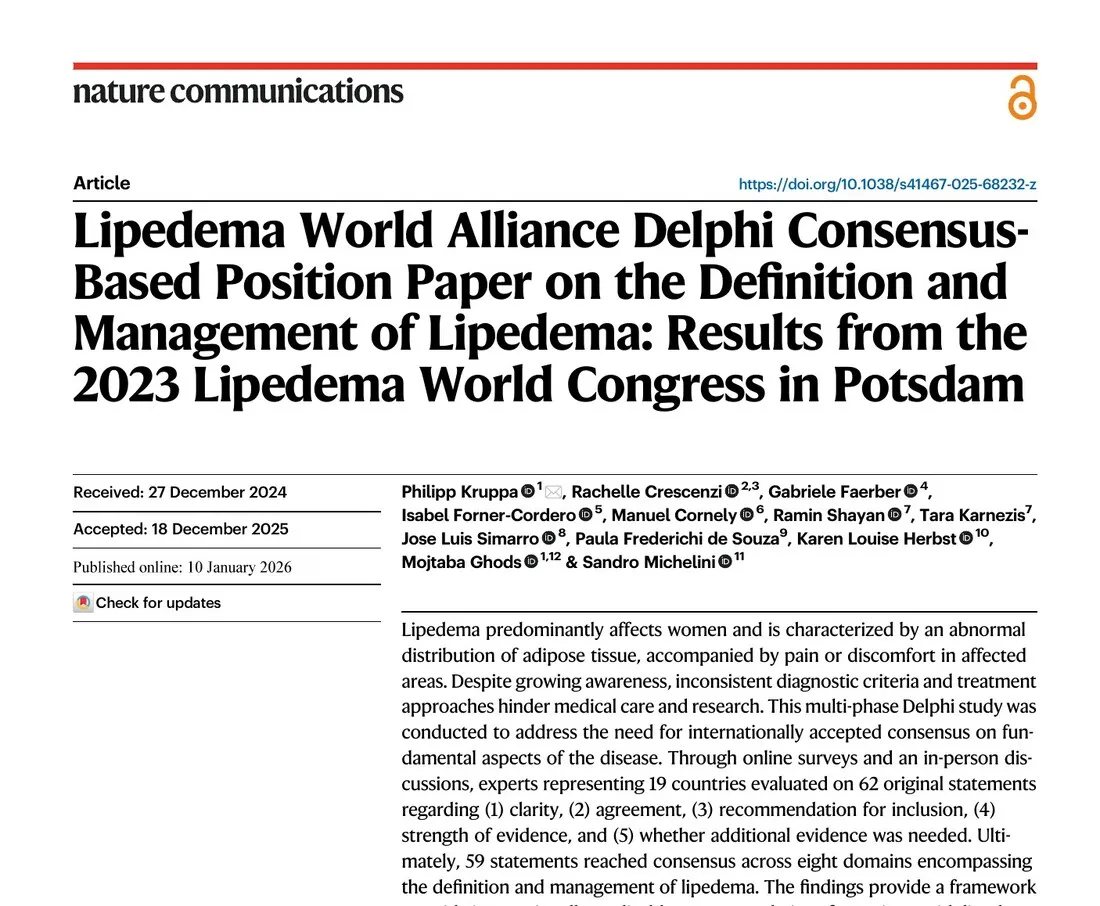
Five common myths about lipedema, and what the evidence says
Is lipedema just obesity? Does it always get worse? Five widespread myths about lipedema, and what guidelines, reviews and the LWA consensus actually say.

LWA editorial team

Key facts
- Lipedema is not an obesity-related comorbidity, although both often occur together.
- Lipedema is not lymphedema, but lymphatic problems can be added later.
- The 2024 S2k guideline says stages shall not be used to measure severity.
- No treatment is described as removing the disease. Care aims to relieve symptoms.
- The true prevalence of lipedema is unknown.
Misunderstandings about lipedema are common. One widely cited review even carries the words “extremely common misconceptions” in its title [1]. Here are five myths that people with lipedema often meet, and what the current sources say instead.
Myth 1: “Lipedema is just obesity, and a diet will make it go away”
Lipedema is a different condition from obesity, even though the two often occur together. The LWA Delphi consensus states that “Lipedema is not an obesity-related comorbidity” (92.1% agreement), and also that obesity is a frequently observed concomitant disease [2].
The pattern differs. Reviews describe disproportionate, painful fat in the limbs that persists despite weight loss, and state that this tissue is hard to reduce by diet, exercise or bariatric surgery [1, 3, 4]. When weight falls, the trunk can become slimmer while the limbs stay large, so the disproportion can look greater [1, 3, 4].
This does not make diet and activity pointless. The consensus states that “addressing overall weight loss in coincident obesity may result in symptom improvement” [2]. Nutrition and movement remain part of care for coexisting obesity, pain and mobility. They are not described as a cure.
Myth 2: “Lipedema is a form of lymphedema”
Lipedema and lymphedema are separate diagnoses. Uncomplicated lipedema usually spares the feet and shows little pitting [3]. The consensus states that the Kaposi-Stemmer sign, a skin fold test at the second toe, “is usually negative in lipedema” (95.5% agreement) [2].
A positive Stemmer sign and swelling of the feet point to lymphatic disease [3, 5]. This can be added to lipedema later. The combination is called lipo-lymphedema, and the consensus confirms that “Concomitant lymphostasis can develop in lipedema” [2, 6]. If your feet or hands start to swell, it is worth having this checked.
Myth 3: “Lipedema always gets worse, and the stage shows how bad it is”
Lipedema does not follow a fixed path. The German S2k guideline of 2024 states, with 94.1% consensus, that lipedema shall not be regarded as a principally progressive disease, because progression depends on several factors. With a stable weight, it can remain stable [7].
The familiar stages describe how the skin and fat look. The guideline states, with 100% consensus, that these morphological stages shall not be used to measure severity, and that pain does not correlate with the degree of disproportion [7]. The consensus agrees that progression of symptoms “depends on various factors and is not universal” (95.1% agreement) [2].
Older texts described a “stage 4” with added lymphedema. The Lipedema Foundation no longer uses that label [6].
Myth 4: “Compression, lymphatic drainage or exercise will remove the lipedema fat”
The guidelines describe these measures as symptom care, not as a way to remove the disease. The S2k guideline places compression, movement and exercise, weight management and self-management within the care of symptoms and function [7]. The consensus states that all therapeutic interventions aim “at alleviating symptoms and preventing or delaying progression” [2].
The evidence is still limited. A 2020 review called the evidence on treatment poor, and separated complex decongestive therapy from observational reports on liposuction [8]. The consensus notes that pain and sensitivity have been reported to be reduced by several approaches, among them compression, decongestive therapy, dietary changes, tailored exercise and surgery, “with varying effect sizes and durations” [2]. The S2k guideline adds that liposuction is not a weight-loss method [7].
None of these sources promises that the disease will disappear. What they do support is this: “Active self-management can help control lipedema-related symptoms and improve the overall quality of life” (91.7% agreement) [2].
Myth 5: “Lipedema is extremely rare, or it affects 11% of all women”
Both statements go further than the evidence. The true prevalence is unknown, and the consensus puts the range of estimates at “less than 1% to up to 12%” [2].
The figures come from very different studies:
- Child and colleagues reported a minimum of 1 in 72,000 at one UK clinic and called this a significant underestimate [3].
- The figure of about 11% goes back, as cited by Buso and colleagues, to Földi’s observations among women admitted for leg swelling, a selected clinic population [9]. Buck and Herbst repeat it as a worldwide estimate [1].
- Marshall and Schwahn-Schreiber found 9.7% or 39% in 62 working women in Germany, depending on whether mild findings were counted [10].
These numbers are not interchangeable, and better population data are still needed.
What does this mean for you?
Myths like these can add to the burden of the disease. The consensus calls raising awareness “essential to reduce misdiagnosis and stigma” [2]. If the descriptions above sound familiar, talk to a specialist who knows lipedema. The diagnosis is made through history and examination [2], and care is planned to fit the individual. The consensus calls for a multidisciplinary approach and notes that psychological and social support “can be important to address the symptom burden” [2].
Our patient page explains the next steps, and our members page shows organisations in the LWA network.
This article was prepared for the LWA website relaunch and is awaiting medical review by the LWA board.
Questions and answers
Will losing weight cure lipedema?
Does lipedema always progress to lymphedema?
What can I do if I think I have lipedema?
Sources
- Buck DW 2nd, Herbst KL. Lipedema: a relatively common disease with extremely common misconceptions. Plast Reconstr Surg Glob Open. 2016;4(9):e1043. doi:10.1097/GOX.0000000000001043 doi.org/10.1097/GOX.0000000000001043
- Kruppa P, Crescenzi R, Faerber G, et al. Lipedema World Alliance Delphi consensus-based position paper on the definition and management of lipedema: results from the 2023 Lipedema World Congress in Potsdam. Nat Commun. 2026;17:427. doi:10.1038/s41467-025-68232-z doi.org/10.1038/s41467-025-68232-z
- Child AH, Gordon KD, Sharpe P, et al. Lipedema: an inherited condition. Am J Med Genet A. 2010;152A(4):970-976. doi:10.1002/ajmg.a.33313 doi.org/10.1002/ajmg.a.33313
- Herbst KL, Kahn LA, Iker E, et al. Standard of care for lipedema in the United States. Phlebology. 2021;36(10):779-796. doi:10.1177/02683555211015887 doi.org/10.1177/02683555211015887
- Deutsche Gesellschaft für Phlebologie und Lymphologie. S2k-Leitlinie Lipödem. AWMF 037-012, version 5.0. 2024. register.awmf.org/de/leitlinien/detail/037-012
- Lipedema Foundation. Staging of lipedema. Updated July 2025. www.lipedema.org/staging
- Faerber G, Cornely M, Daubert C, et al. S2k guideline lipedema. J Dtsch Dermatol Ges. 2024;22(9):1303-1315. doi:10.1111/ddg.15513 doi.org/10.1111/ddg.15513
- Kruppa P, Georgiou I, Biermann N, et al. Lipedema: pathogenesis, diagnosis, and treatment options. Dtsch Arztebl Int. 2020;117(22-23):396-403. doi:10.3238/arztebl.2020.0396 doi.org/10.3238/arztebl.2020.0396
- Buso G, Depairon M, Tomson D, et al. Lipedema: a call to action! Obesity (Silver Spring). 2019;27(10):1567-1576. doi:10.1002/oby.22597 doi.org/10.1002/oby.22597
- Marshall M, Schwahn-Schreiber C. Prävalenz des Lipödems bei berufstätigen Frauen in Deutschland (Lipödem-3-Studie). Phlebologie. 2011;40(3):127-134. doi:10.1055/s-0037-1621766 doi.org/10.1055/s-0037-1621766
This article is general information and does not replace a consultation with a physician. If you think you may have lipedema, please talk to a specialist in phlebology, lymphology, angiology or plastic surgery.