Evidence for lipedema care
For physicians, therapists and researchers: the international LWA position paper, the guidelines that shape care today and the questions the field still has to answer.

The LWA Delphi consensus on lipedema
The first international position paper of the alliance defines lipedema and sets out how it should be diagnosed and managed. Experts rated the statements online and voted in person at the world congress in Potsdam.
- 62statements rated
- 59reached consensus at 70 % agreement
- 8domains
- 19countries on five continents
- 71experts in the final round
How to cite
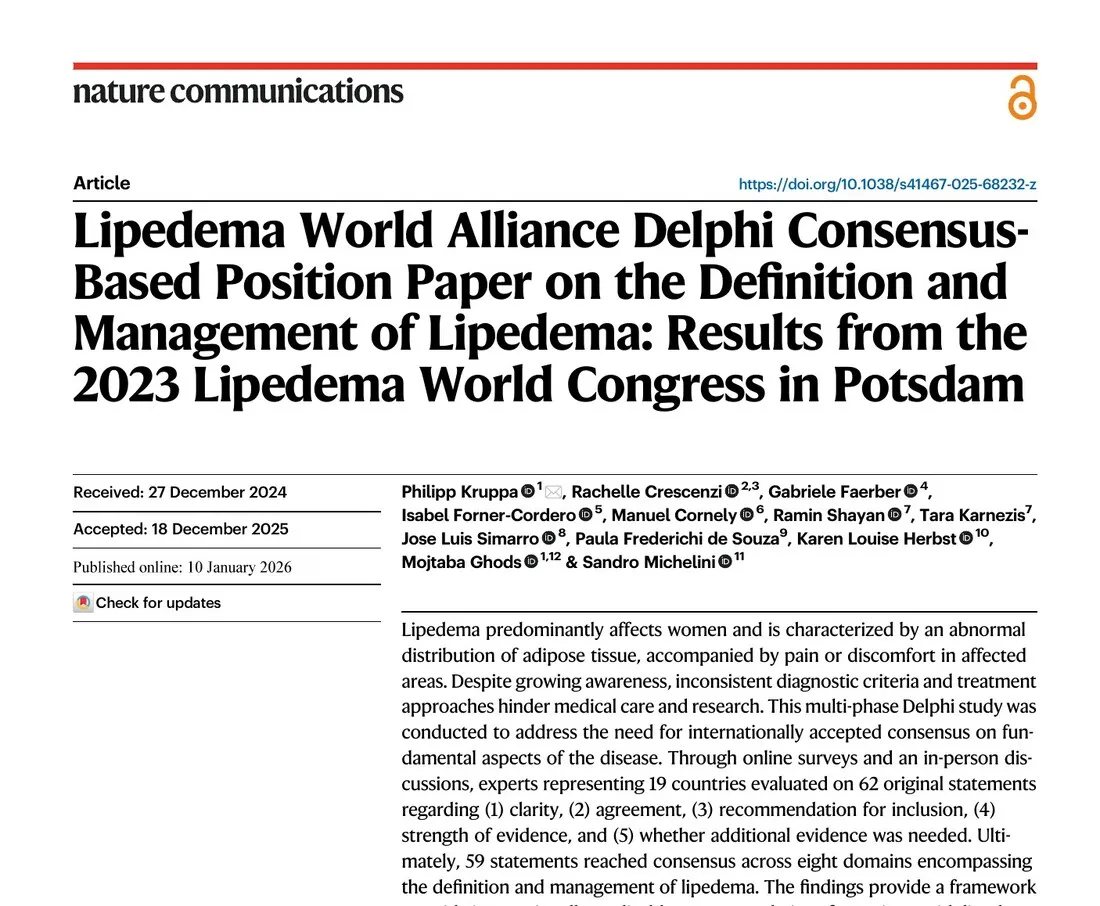
Kruppa P, Crescenzi R, Faerber G, Forner-Cordero I, Cornely M, Shayan R, Karnezis T, Simarro JL, Frederichi de Souza P, Herbst KL, Ghods M, Michelini S. Lipedema World Alliance Delphi consensus-based position paper on the definition and management of lipedema: results from the 2023 Lipedema World Congress in Potsdam. Nat Commun. 2026;17:427. doi:10.1038/s41467-025-68232-z
The eight domains
Definition and leading symptoms
-
“Lipedema is a chronic disease”
-
“Untreated lipedema typically presents as symmetrical, bilateral enlargement of subcutaneous adipose tissue in the extremities, accompanied by pain and/or discomfort”
-
“Kaposi-Stemmer’s sign is usually negative in lipedema”
Pathophysiology
-
“Lipedema is a disease involving subcutaneous adipose tissue”
-
“Numerous findings suggest that inflammation may contribute to the pathogenesis of lipedema”
-
“Numerous findings suggest that hormonal factors may contribute to the pathogenesis of lipedema”
Epidemiology
-
“Lipedema primarily affects biological females. Occurrence in biological males appears to be possible but rare”
-
“Hormonal changes may trigger or exacerbate the symptoms of lipedema”
-
“The prevalence of lipedema in the adult female population remains unknown. Estimates range from less than 1% to up to 12%”
Comorbidities and concomitant diseases
-
“Obesity is a frequently observed concomitant disease in patients with lipedema”
-
“Lipedema is not an obesity-related comorbidity”
-
“Body mass index (BMI) has limited value in distinguishing between lipedema and obesity. Therefore, it is advisable to utilize the Waist-to-Height Ratio (WHtR) to exclude or assess obesity”
Quality of life and symptom burden
-
“Lipedema can negatively impact mental health and overall quality of life”
-
“If present, psychological involvement may be caused by lipedema-related symptoms rather than being the cause of those symptoms”
-
“Missed or delayed diagnosis or management of lipedema increases the cost burden for patients and the healthcare system”
Diagnostic approach
-
“The clinical diagnosis of lipedema relies on the patient’s medical history, physical examination and exclusion of differential diagnoses”
-
“Currently, no imaging, serological or genetic tests, or clinical measurement instruments, are officially approved to verify the clinical diagnosis”
-
“The clinical classification of lipedema into stages does not reflect the complete symptom severity”
Treatment modalities
-
“All therapeutic interventions of lipedema aim at alleviating symptoms and preventing or delaying progression”
-
“Currently, there is no evidence for the effectiveness of any pharmacological interventions in treating lipedema”
-
“Lymph vessel-sparing lipedema reduction surgery should be considered when there is potential for a positive impact on lipedema-related symptoms”
Future directions
-
“Raising awareness about lipedema within the medical community and wider society is essential to reduce misdiagnosis and stigma”
-
“A comprehensive standardized case report form (CRF) should be developed to improve consistency in diagnosis, lipedema reporting, follow-up, and research, and to facilitate, for example, both cohort and longitudinal studies”
-
“Collaborative efforts between patients, researchers, clinicians and advocacy groups are crucial for advancing knowledge. Translational practice-based application of research knowledge should improve patient care”
Guidelines at a glance
National and international documents differ in method and scope, but agree on many points. Always check the current version with the issuing society.
| Document | Year | Type | Key points | Source |
|---|---|---|---|---|
| LWA Delphi consensus-based position paperLipedema World Alliance, Nature Communications | 2026 | International Delphi consensus | 59 of 62 statements reached consensus across 8 domains, from definition to future research. | 10.1038/s41467-025-68232-z |
| S2k guideline lipedema (AWMF 037-012)German Society of Phlebology and Lymphology, J Dtsch Dermatol Ges | 2024 | National consensus guideline (S2k) | 60 recommendations. BMI alone is not conclusive, WHtR is used. Morphological stage shall not be used as a measure of severity. Valid until January 2029. | 10.1111/ddg.15513 |
| Standard of care for lipedema in the United StatesHerbst KL et al., Phlebology | 2021 | Delphi consensus, rated with GRADE | 85 statements on pathophysiology and on medical, surgical, vascular and other care. | 10.1177/02683555211015887 |
| Lipoedema: a paradigm shift and consensusEuropean Lipoedema Forum, Bertsch T et al., J Wound Care | 2020 | Expert consensus, seven countries | Consensus supplement on the understanding and management of lipoedema. Its view of pathophysiology is not identical to every later guideline. | 10.12968/jowc.2020.29.Sup11b.1 |
| First Dutch guidelines on lipedemaHalk AB, Damstra RJ, Phlebology | 2017 | National guideline using the ICF | Diagnosis, a minimum set of measurements and conservative pillars. Surgery is named as the only method for correcting the abnormal fat tissue. | 10.1177/0268355516639421 |
| Best Practice Guidelines: the management of lipoedemaWounds UK | 2017 | Best practice document | UK document on the management of lipoedema, listed by the German-speaking lymphology society next to the S2k guideline. | Listed at gdlymph.eu |
Sources: the documents listed, and the fact base of this website. Summaries are shortened and do not replace the original texts.
Research
Open questions the field has to answer
At the world congress in Rome in 2025, clinicians, researchers and patient organisations named the areas that need further study. The consensus adds its own research agenda.
-
Mechanisms and genetics
The biological mechanisms behind lipedema are still unclear. Genetics was named as a priority in the closing panel in Rome.
Delphi statement 56. Rome 2025 report.
-
An objective diagnosis
Diagnosis is clinical today. A micro-RNA from affected tissue is being studied as a possible first biological marker, and diagnostic methods need validation.
Delphi statement 57. Rome 2025 report.
-
Long-term treatment evidence
Long-term studies on the efficacy and safety of conservative and surgical treatment are required, including clinical trials.
Delphi statement 58. Rome 2025 report.
-
Medicines, including GLP-1 agonists
There is no evidence yet for any drug treatment of lipedema. For GLP-1 agonists, dosage, duration, side effects and cost still need to be defined.
Delphi statement 50. Rome 2025 round table.
-
Role of the lymphatic system
Concomitant lymphostasis can develop. Whether the lymphatic system plays a role in the origin of lipedema was debated intensely in Rome.
Delphi statement 24. Rome 2025 report.
-
Standardised data
A shared case report form and biobanks would make cohorts comparable across centres and countries.
Delphi statement 55. Rome 2025 report.
Find and register studies
Planned and running trials are listed in public registries. Running a study or a registry? Tell the alliance so that members can find it.
Tell us about your studyEducation and congresses
The world congresses are where the field meets every two years. Between them, the alliance runs online sessions with members of its board.
World congresses
- 2023 1st Lipedema World Congress Potsdam, 5 to 7 October 2023 More than 500 participants from more than 35 countries. Venue of the in-person Delphi vote.
- 2025 Lipedema World Congress Rome, 5 to 8 November 2025 More than 870 participants from 40 countries and over 250 scientific contributions.
- 2026 13th ILF Conference and 10th ITALF Congress Rome, 28 to 31 October 2026 In partnership with the LWA, the International Lipoedema Association and the European Society of Lymphology.
- 2027 Lipedema World Congress III Melbourne, 11 to 14 November 2027 Together with the Lipoedema Australia Conference VII at the Crown Conference Centre.
Webinar series with board members
- 12 June 2024What’s new in nutrition for lipedemaDr. Gabriele Faerber
- 19 June 2024Clinical diagnosis and differential diagnosis: differentiating lipedema from obesity, cellulite and lymphedemaDr. Jose Luis Simarro
- 19 June 2024Lipedema: contribution of scientific research to clinical practiceDr. Sandro Michelini
- 24 June 2024LWA Delphi consensus-based position paper: interim resultsDr. Philipp Kruppa
- 26 June 2024What we know about compressionDr. Isabel Forner Cordero
- 26 June 2024Benefits of lipedema reduction surgery: leg pain, mobility and knee mechanicsDr. Thomas Wright
Questions from professionals
How was the Delphi consensus developed?
All 103 founding members of the LWA were invited. The statements were rated online in three rounds and discussed in person at the Lipedema World Congress in Potsdam on 7 October 2023. 71 experts from 19 countries on five continents took part in round three. Consensus required at least 70 % agreement.
How does the consensus relate to national guidelines?
The consensus is the official position of the LWA and is meant to be applicable internationally. National guidelines such as the German S2k guideline remain the reference for care in their countries. At the Rome congress 2025 the official documents were compared and were found to converge on many points.
How should I cite the consensus?
Kruppa P, Crescenzi R, Faerber G, Forner-Cordero I, Cornely M, Shayan R, Karnezis T, Simarro JL, Frederichi de Souza P, Herbst KL, Ghods M, Michelini S. Lipedema World Alliance Delphi consensus-based position paper on the definition and management of lipedema: results from the 2023 Lipedema World Congress in Potsdam. Nat Commun. 2026;17:427. doi:10.1038/s41467-025-68232-z. The paper is open access in Nature Communications.
How can my institution contribute to research?
Tell us about your study or registry through the contact form. The alliance connects research groups, clinicians and patient organisations, and the consensus calls for a shared case report form and long-term studies.
Where are calls for abstracts published?
Calls for abstracts are announced on the website of each congress. For Melbourne 2027 please follow lwc2027.com. Dates for submissions are still to be confirmed by the organisers.
Join the alliance as a professional
Physicians, researchers and therapists working on lipedema are welcome as members. Fees will be published with the new membership process.