

Understanding lipedema

Clear information on symptoms, diagnosis and treatment, based on the international LWA consensus and current guidelines. It cannot replace a visit to a specialist, but it can help you prepare for one.

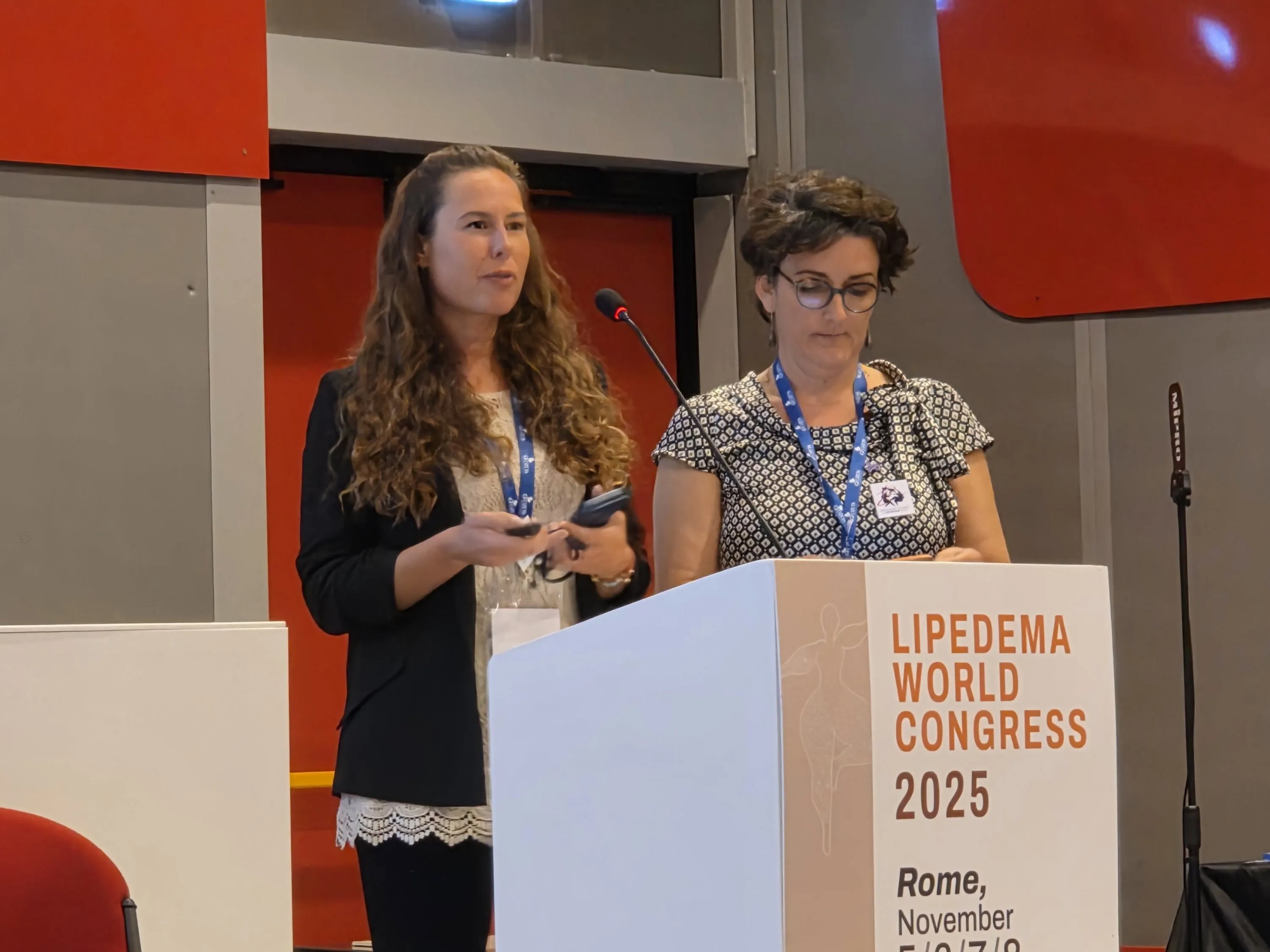
Patient representatives at the lectern of the Lipedema World Congress 2025 in Rome

What is lipedema?

Lipedema is a chronic disease of the fat tissue under the skin.1 Untreated, it typically shows as a symmetrical enlargement of this tissue on both sides of the body, in the legs and often in the arms, together with pain or discomfort. The limbs are affected far more than the torso, while hands and feet are usually spared.1

The German S2k guideline of 2024 describes lipedema as a painful condition that can restrict quality of life. It also states that lipedema shall not be regarded as a disease that always progresses: with a stable weight it can remain stable.2,3

The World Health Organization lists lipoedema in the 11th revision of its International Classification of Diseases under code EF02.2. ICD-11 came into effect on 1 January 2022, and each country decides when to use it.4

In the words of the international consensus

Statements 1 to 5 of the LWA Delphi consensus, published in Nature Communications 2026.1

  • 71experts voted
  • 19countries on 5 continents
  • 59statements agreed

94.4 %agreement

“Lipedema is a chronic disease.”

  • 88.6 %agreement

    “Untreated lipedema typically presents as symmetrical, bilateral enlargement of subcutaneous adipose tissue in the extremities, accompanied by pain and/or discomfort.”

  • 89.6 %agreement

    “Lipedema is characterized by a disproportional expansion of the subcutaneous adipose tissue of the extremities compared to that in the torso.”

  • 94.0 %agreement

    “Lipedema can involve excess adipose tissue deposition in the upper extremities in a symmetrical and bilateral distribution.”

  • Agreed statement

    “Lipedema typically spares hands and feet of excess fat deposition.”

About the consensus paper

Typical signs and symptoms

Lipedema looks different from person to person. These are the features that experts describe most often.

A lecture hall full of participants at the 1st Lipedema World Congress in Potsdam, 2023
  1. Both sides of the body

    Fat tissue under the skin increases symmetrically, usually in the legs and often in the arms.1

  2. Out of proportion

    Arms and legs are affected much more than the torso.1

  3. Hands and feet spared

    Hands and feet typically stay free of the extra fat tissue.1

  4. Pain or tenderness

    Affected areas are sensitive to pressure or stretch, often felt as pain.1

Also often described

  • Swelling or heaviness. Many people describe a feeling of swelling or heavy limbs.1

  • Easy bruising. Bruises appear easily in the affected areas.1

  • No lasting dent. Pressing on the skin usually does not leave a dent (no pitting oedema).1

  • Hormonal changes. Puberty, pregnancy or menopause may trigger or worsen the symptoms.1,5,6

Having one or more of these features does not mean that you have lipedema. Only an examination by an experienced specialist can confirm or rule out the diagnosis.

Diagnosis

How lipedema is diagnosed

The diagnosis is clinical. At present no imaging, blood or genetic test is officially approved to confirm it.1 What counts is an experienced look at your history and body.

What happens at the appointment

  1. Your medical history

    When the changes began, where you feel pain, bruising, earlier treatments and whether relatives have similar features.1

  2. Physical examination

    Distribution of fat tissue, hands and feet, sensitivity to pressure, pitting and the Stemmer sign at the base of the second toe.1

  3. Measurements

    Weight, height, waist and hip. The waist-to-height ratio (WHtR) helps because BMI alone has limited value here.1,2

  4. Ruling out other causes

    Obesity, lymphedema and other reasons for enlarged or swollen limbs are considered before the diagnosis is made.1

Lipedema, obesity and lymphedema compared

FeatureLipedemaObesityLymphedema
What it isA chronic disease of the fat tissue under the skin1 Excess body fatSwelling caused by a disorder of the lymphatic system
Typical patternSymmetrical, limbs much more than the torso1 Not limited to the limbs, torso included7 Swelling of a limb, usually including the foot or hand6
Hands and feetUsually spared1 No typical sparingOften involved6
Pain and bruisingTenderness, pain and easy bruising are typical1 Not typical featuresNot defining features
Stemmer signUsually negative1 Not a featurePositive6
Effect of dietAffected fat largely resistant to diets1 Body fat decreases with weight lossSwelling is not caused by fat tissue

A simplified overview for orientation. The conditions can occur together: obesity is a frequent companion of lipedema, and lymph congestion can develop in lipedema (lipo-lymphedema).1 The German guideline calls a symmetrical, disproportionate fat distribution without pain lipohypertrophy, which is not lipedema.3

Treatment options

All treatments for lipedema aim to relieve symptoms and to prevent or delay progression. Good care is shared between several professions and tailored to your needs.1

Conservative care

Experts agree that conservative management should include lifestyle and nutrition, compression therapy and exercise.1

  • Compression garments or bandaging
  • Tailored exercise such as activity in water, walking or yoga
  • Nutritional guidance and weight optimisation, especially if obesity is also present
  • Complete decongestive therapy where needed. Not every component is required for every patient.
  • Psychological and social support

Currently there is no evidence that any medicine is effective in treating lipedema itself.1

Surgical care

Lymph vessel-sparing lipedema reduction surgery, a form of liposuction, should be considered when it can have a positive effect on the symptoms.1

  • Performed by teams with extensive knowledge of lipedema, including conservative care
  • If obesity and metabolic disease are also present, these are treated first
  • Liposuction is not a method for losing weight

Sources: LWA consensus 2026 and German S2k guideline 2024.1,2

Which option is right depends on an individual assessment by a specialist. Once your condition and the possible approaches have been explained to you, the decision is taken together with you.

Patient representatives in a panel discussion at the Lipedema World Congress 2025 in Rome

Living with lipedema

Lipedema can affect mental health and quality of life. Symptoms are a burden of their own, and psychological strain is often a result of them, not their cause.1

  • Self-management

    Active self-management can help to control symptoms and improve overall quality of life.1

  • Movement

    Tailored exercise such as water activity, walking or yoga can help to stay mobile and ease symptoms.1

  • Psychosocial support

    Support on body image, mental wellbeing and coping can be an important part of care.1

  • Patient organisations

    National patient associations offer contact with others and know local care. Many are members of the alliance.

    Find members near you

Find specialised care

Start with the alliance's member organisations in your country. Patient associations and specialist centres know experienced care nearby. A reviewed directory of centres is being built with them.

Frequently asked questions

Is lipedema the same as being overweight?

No. The international consensus states that lipedema is not an obesity-related comorbidity, and that the extra limb volume is generally not associated with obesity. Both can occur together, which is common. Because BMI has limited value in telling them apart, specialists also use the waist-to-height ratio. (Source 1)

Can diet or exercise make lipedema go away?

The affected fat tissue is known to be largely resistant to diets. Nutritional guidance, tailored exercise and weight loss when obesity is also present can still help with symptoms and overall health. These measures are part of care, not a cure. (Source 1)

Does lipedema always get worse over time?

Not necessarily. Experts agree that a progression of symptoms depends on various factors and is not universal. The German S2k guideline states that lipedema shall not be regarded as a principally progressive disease. (Sources 1 and 2)

Is there a test that confirms lipedema?

Not at present. No imaging, blood or genetic test and no measurement instrument is officially approved to verify the diagnosis. It is made clinically from your history, an examination and the exclusion of other conditions. (Source 1)

Which specialist should I see?

Care for lipedema is multidisciplinary and may involve physicians, physical therapists, dietitians and mental health professionals. Which specialty you see first differs from country to country. National patient organisations often know experienced centres. (Source 1)

Is lipedema inherited?

In some cases, yes. The consensus states that lipedema is hereditary in some cases, and family histories over several generations have been described. (Sources 1 and 6)

Can men have lipedema?

Lipedema primarily affects biological females. Occurrence in biological males appears to be possible but rare. (Source 1)

Will my health insurance cover treatment?

That depends on the country and on your insurance. In Germany, for example, the Federal Joint Committee decided in July 2025 that liposuction for lipedema is covered by statutory health insurance under set conditions. Please ask your insurer or a patient organisation in your country. (Source 8)

Sources

  1. Kruppa P, Crescenzi R, Faerber G, et al. Lipedema World Alliance Delphi consensus-based position paper on the definition and management of lipedema: results from the 2023 Lipedema World Congress in Potsdam. Nat Commun. 2026;17:427. doi.org/10.1038/s41467-025-68232-z
  2. Faerber G, Cornely M, Daubert C, et al. S2k guideline lipedema. J Dtsch Dermatol Ges. 2024;22(9):1303-1315. doi.org/10.1111/ddg.15513
  3. Deutsche Gesellschaft für Phlebologie und Lymphologie. S2k guideline lipedema, AWMF register 037-012, version 5.0, 2024. register.awmf.org/de/leitlinien/detail/037-012
  4. Lipedema Foundation. ICD (diagnosis) codes. Accessed 5 November 2026. lipedema.org/icd-codes
  5. Herbst KL, Kahn LA, Iker E, et al. Standard of care for lipedema in the United States. Phlebology. 2021;36(10):779-796. doi.org/10.1177/02683555211015887
  6. Child AH, Gordon KD, Sharpe P, et al. Lipedema: an inherited condition. Am J Med Genet A. 2010;152A(4):970-976. doi.org/10.1002/ajmg.a.33313
  7. Buck DW 2nd, Herbst KL. Lipedema: a relatively common disease with extremely common misconceptions. Plast Reconstr Surg Glob Open. 2016;4(9):e1043. doi.org/10.1097/GOX.0000000000001043
  8. Lipedema World Alliance. Great news for women in Germany on health insurance funded lipedema liposuction. 18 July 2025. With the press release of the Federal Joint Committee (G-BA). lipedemaworldalliance.com, news of 18 July 2025

Medical note. This page offers general information about lipedema. It does not replace a consultation, a diagnosis or a treatment plan by a qualified healthcare professional. Please talk to a specialist about your own situation.

Last updated 5 November 2026. Medical review by the LWA board pending.

Patient organisations are part of the alliance

National patient associations sit on the board next to physicians and researchers. Find the members in your country or get in touch with us.