The LWA Delphi consensus: 59 statements on lipedema
How 71 experts from 19 countries agreed on 59 statements about lipedema, what the eight domains cover and how the consensus sits beside other guidelines.

LWA editorial team
Key facts
- Published in Nature Communications on 10 January 2026 (2026;17:427).
- 62 statements were rated, and 59 reached the pre-set consensus threshold of 70% agreement.
- 71 experts from 19 countries on five continents took part in the third round.
- The statements cover eight domains, from definition to future research.
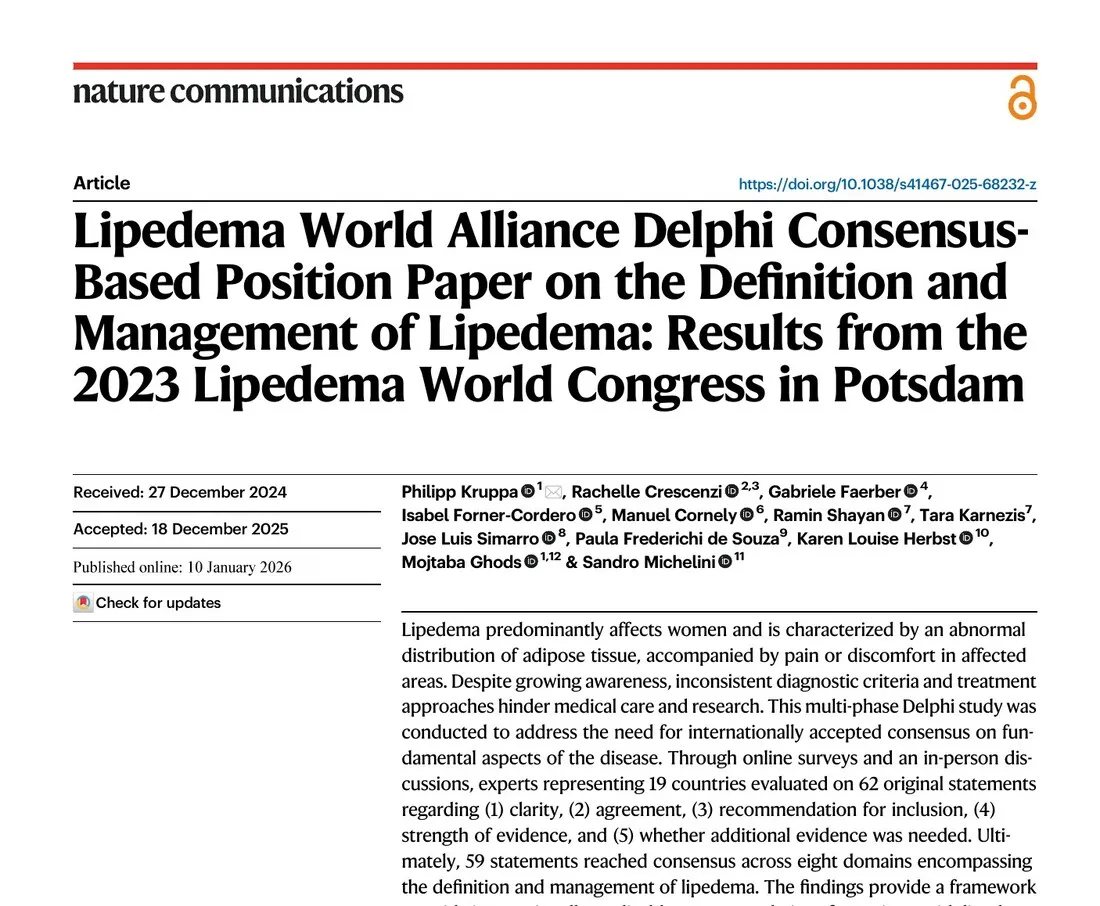
The Lipedema World Alliance has published its first international consensus on lipedema. The paper appeared in Nature Communications on 10 January 2026 and contains 59 statements on which experts from 19 countries agreed [1].
What is the LWA Delphi consensus?
It is a position paper on the definition and management of lipedema, based on a structured expert vote. Its full title is “Lipedema World Alliance Delphi Consensus-Based Position Paper on the Definition and Management of Lipedema: Results from the 2023 Lipedema World Congress in Potsdam” [1].
The authors are Philipp Kruppa, Rachelle Crescenzi, Gabriele Faerber, Isabel Forner-Cordero, Manuel Cornely, Ramin Shayan, Tara Karnezis, Jose Luis Simarro, Paula Frederichi de Souza, Karen Louise Herbst, Mojtaba Ghods and Sandro Michelini. The project was led by the LWA [1].
The abstract opens with this sentence: “Lipedema predominantly affects women and is characterized by an abnormal distribution of adipose tissue, accompanied by pain or discomfort in affected areas.” [1]
How was the consensus developed?
The consensus is the result of a multi-phase Delphi study. Experts rated statements in three online rounds, and the results were discussed in person at the Lipedema World Congress in Potsdam on 7 October 2023 [1].
- All 103 founding members of the LWA were invited.
- 71 of them took part in the third round: 34 women and 37 men from 19 countries on five continents.
- Patient representatives from seven countries were among them.
- The experts evaluated 62 original statements for clarity, agreement, recommendation for inclusion, strength of evidence and whether more evidence was needed.
The participants came from Australia, Austria, Belgium, Brazil, Denmark, Germany, Greece, Hungary, India, Italy, Norway, Poland, Portugal, Spain, Sweden, Switzerland, Turkey, the United Kingdom and the United States [1].
How many statements reached agreement?
59 of the 62 statements reached consensus at the pre-set threshold of 70% agreement. 36 statements reached 90 to 100% agreement and 17 reached 80 to 90%. The remaining six passed the 70% threshold [1]. The journal received the paper on 27 December 2024 and accepted it on 18 December 2025 [1].
What do the eight domains cover?
The 59 statements are grouped into eight domains. Here is one statement from each, quoted word for word, with the level of agreement reported in the paper [1]:
- Definition and leading symptoms: “Lipedema is characterized by a disproportional expansion of the subcutaneous adipose tissue of the extremities compared to that in the torso” (89.6%).
- Pathophysiology: “Numerous findings suggest that hormonal factors may contribute to the pathogenesis of lipedema” (96.9%).
- Epidemiology: “The prevalence of lipedema in the adult female population remains unknown. Estimates range from less than 1% to up to 12%” (79.0%).
- Comorbidities and concomitant diseases: “Lipedema is not an obesity-related comorbidity” (92.1%).
- Impact on quality of life and symptom burden: “If present, psychological involvement may be caused by lipedema-related symptoms rather than being the cause of those symptoms” (90.2%).
- Diagnostic approach: “The clinical diagnosis of lipedema relies on the patient’s medical history, physical examination and exclusion of differential diagnoses” (98.4%).
- Treatment modalities: “All therapeutic interventions of lipedema aim at alleviating symptoms and preventing or delaying progression” (90.2%).
- Future directions: “A comprehensive standardized case report form (CRF) should be developed to improve consistency in diagnosis, lipedema reporting, follow-up, and research, and to facilitate, for example, both cohort and longitudinal studies” (96.7%).
What does the consensus mean for practice and research?
The authors see the statements as a framework for recommendations that can be applied internationally. Because the evidence is limited, they call for more research, standardised data collection and international collaboration between clinicians, researchers and patient representatives [1].
For clinical practice
Several statements give clinicians a shared starting point [1]:
- Routine examinations should include standardised measurements such as waist-to-height ratio, waist-to-hip ratio and BMI.
- The current classification into stages has limited relevance for disease management.
- Progression of symptoms “depends on various factors and is not universal”.
- Comprehensive management requires a multidisciplinary approach tailored to individual needs.
- There is currently no evidence for the effectiveness of any pharmacological treatment.
For research
The last domain sets out a research agenda. Besides the standardised case report form, it calls for studies that validate diagnostic methods, long-term studies on the efficacy and safety of treatments, and further work on the biological mechanisms of lipedema [1]. A consensus records where experts agree. It does not replace these studies.
How does it relate to the S2k guideline and the US standard of care?
The Delphi consensus is the newest of three major documents and the only one of them built on an international expert vote. The S2k guideline comes from Germany, the standard of care from a US committee.
- German S2k guideline (2024). Led by the Deutsche Gesellschaft für Phlebologie und Lymphologie, version 5.0 of 22 January 2024. S2k means a structured consensus guideline, not an evidence-graded S3 guideline. The English short version reports 60 recommendations on diagnosis, conservative care, surgery, psychosocial factors and self-management [2].
- US standard of care (2021). Published by Herbst and colleagues in Phlebology. A US committee reached a Delphi consensus on 85 statements, rated with GRADE, covering pathophysiology and medical, surgical, vascular and other care [3].
The documents agree on central points. The S2k guideline states that morphological stages shall not measure severity and that lipedema shall not be regarded as principally progressive [2]. The LWA consensus says that stages do not reflect the complete symptom severity and that progression is not universal [1]. Both treat BMI alone as an unreliable guide and add the waist-to-height ratio [1, 2].
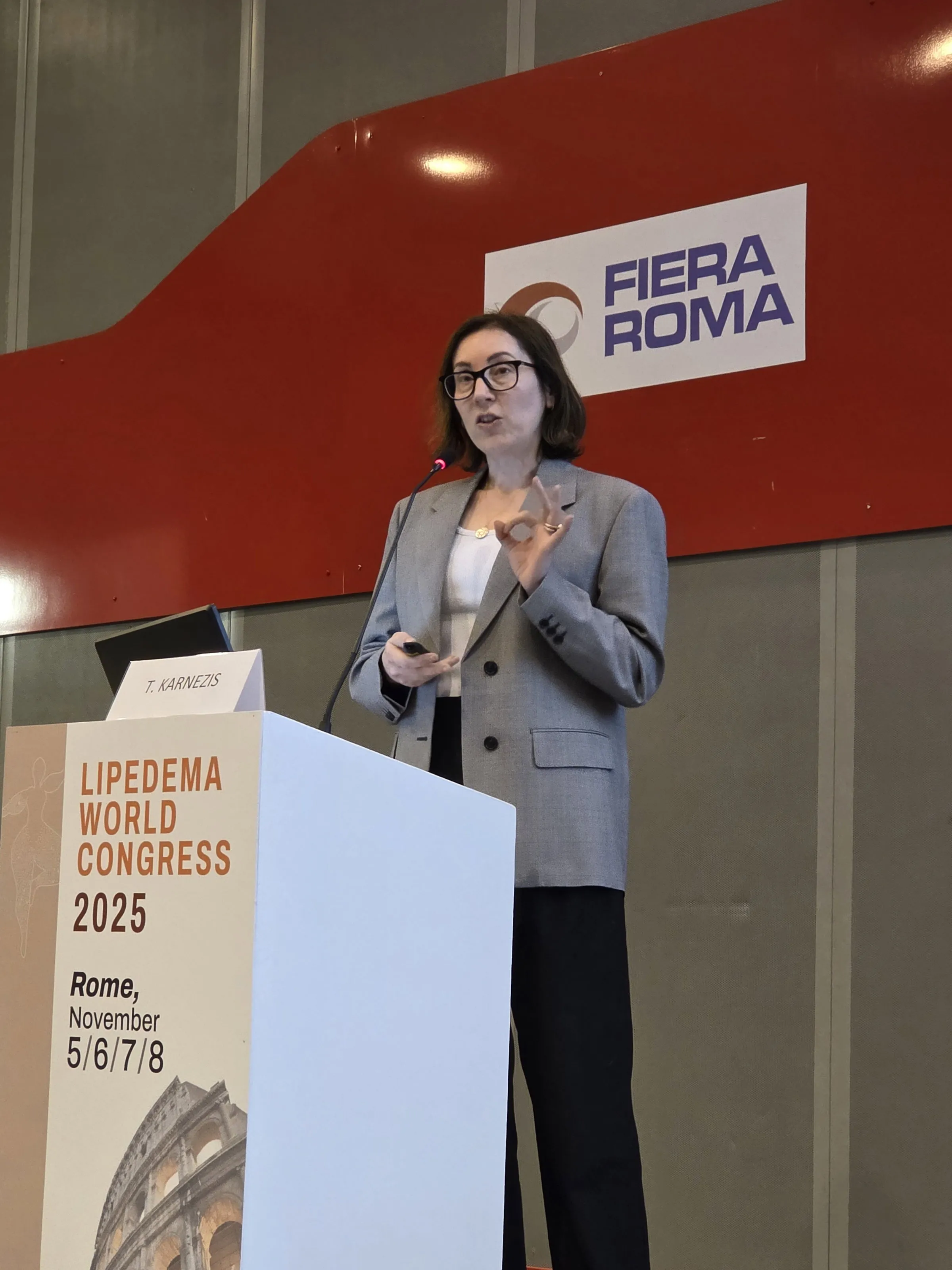
At the 2025 congress in Rome, Philipp Kruppa presented the consensus before publication. According to the congress report, it “constitutes the official position of the LWA Association on all issues related to the disease”, and a comparison of the official documents showed that they “fortunately converge on many points” [4].
More on the consensus and the other guidelines is on our page for professionals.
This article was prepared for the LWA website relaunch and is awaiting medical review by the LWA board.
Questions and answers
Who took part in the LWA Delphi consensus?
Is the Delphi consensus a treatment guideline?
Where can I read the full paper?
Sources
- Kruppa P, Crescenzi R, Faerber G, et al. Lipedema World Alliance Delphi consensus-based position paper on the definition and management of lipedema: results from the 2023 Lipedema World Congress in Potsdam. Nat Commun. 2026;17:427. doi:10.1038/s41467-025-68232-z doi.org/10.1038/s41467-025-68232-z
- Faerber G, Cornely M, Daubert C, et al. S2k guideline lipedema. J Dtsch Dermatol Ges. 2024;22(9):1303-1315. doi:10.1111/ddg.15513 doi.org/10.1111/ddg.15513
- Herbst KL, Kahn LA, Iker E, et al. Standard of care for lipedema in the United States. Phlebology. 2021;36(10):779-796. doi:10.1177/02683555211015887 doi.org/10.1177/02683555211015887
- Michelini S. Report Lipedema World Congress, Rome 5 to 8 November 2025. Lipedema World Alliance. 28 November 2025. lipedemaworldalliance.com/report-lipedema-world-congress/
This article is general information and does not replace a consultation with a physician. If you think you may have lipedema, please talk to a specialist in phlebology, lymphology, angiology or plastic surgery.