Lipedema, lymphedema or obesity? How clinicians tell them apart
Lipedema is often mistaken for obesity or lymphedema. Which signs clinicians look at, why BMI misleads and what lipo-lymphedema and lipohypertrophy mean.

LWA editorial team

Key facts
- No imaging, blood or genetic test is officially approved to confirm lipedema. The diagnosis is clinical.
- Lipedema usually spares hands and feet, and the Kaposi-Stemmer sign is usually negative.
- BMI alone is not conclusive in lipedema. The S2k guideline adds the waist-to-height ratio.
- Lipedema and obesity or lymphedema can occur at the same time.
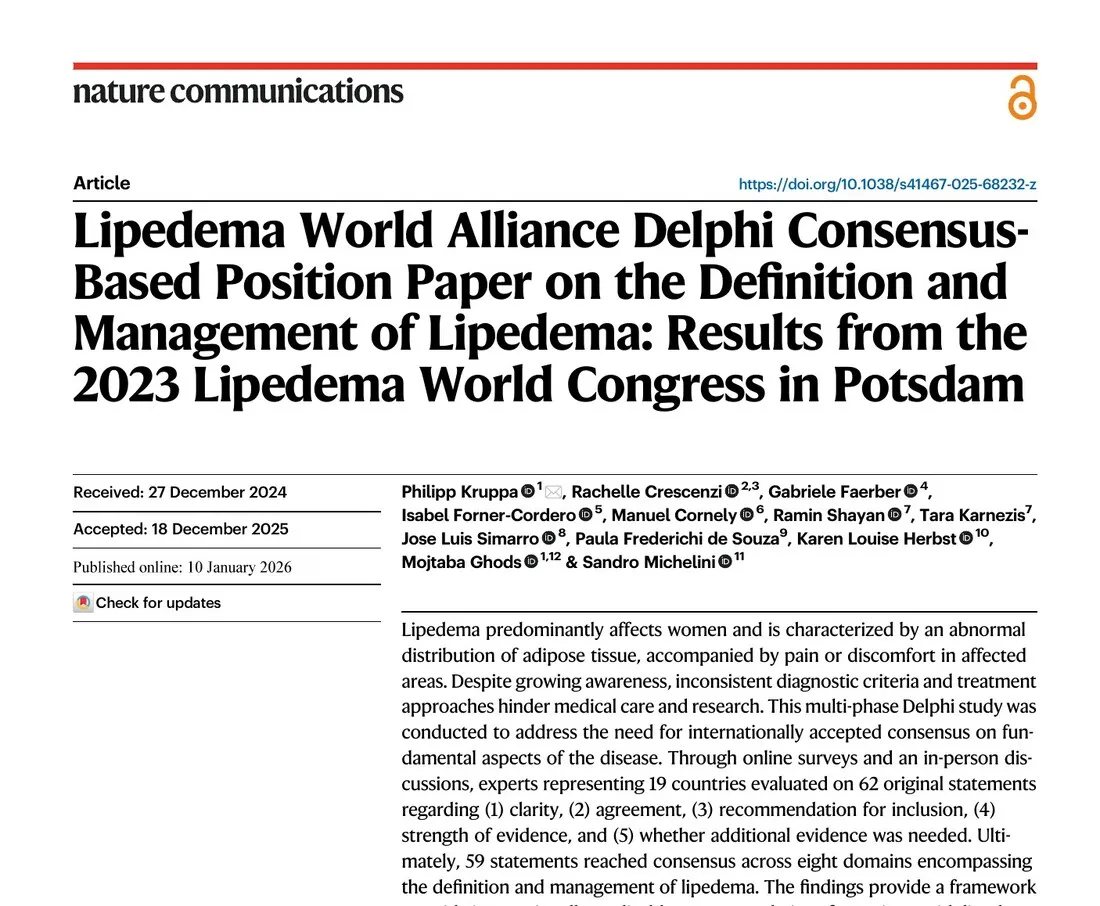
Lipedema can look like obesity or lymphedema, and it can occur together with either of them. This article summarises the signs clinicians use to tell the conditions apart, based on the LWA Delphi consensus, the German S2k guideline of 2024 and two widely cited reviews [1, 2, 3, 4]. It does not replace an examination by a specialist.
Why is lipedema so often misdiagnosed?
There is no single test that proves lipedema. The LWA consensus states that no imaging, serological or genetic test or clinical measurement instrument is officially approved to verify the diagnosis, which relies on the medical history, a physical examination and the exclusion of other conditions [1].
Overlap makes it harder. The consensus notes that obesity is a frequently observed concomitant disease, and that lymphostasis can develop in lipedema [1]. Child and colleagues, describing one UK clinic, called their own prevalence figure a significant underestimate because of misdiagnosis and missed referral [2].
Getting it wrong has consequences. The consensus states that missed or delayed diagnosis negatively affects symptom burden, mental well-being and quality of life, and that raising awareness is “essential to reduce misdiagnosis and stigma” [1].
Which signs help to tell the conditions apart?
Clinicians look at a pattern of findings, not at one sign. The table lists what is typical in lipedema and what can point to another or an additional diagnosis.
| Feature | Typical in lipedema | What can point elsewhere |
|---|---|---|
| Distribution | Symmetrical on both sides, limbs out of proportion to the torso, arms can be involved [1] | A raised waist-to-height ratio points to obesity, which can coexist with lipedema [1, 4] |
| Hands and feet | Usually spared [1, 2] | Swelling that includes the feet suggests lymphedema or lipo-lymphedema [2, 5] |
| Pain | Pain or discomfort in the affected areas; the S2k text treats pain as part of the definition [1, 6] | Symmetrical disproportion without pain is called lipohypertrophy [6] |
| Tenderness and bruising | Sensitivity to pressure or stretch in the enlarged areas, easy bruising [1] | Reviews name pain, tenderness and easy bruising as features that set lipedema apart from obesity [2, 3] |
| Kaposi-Stemmer sign | Usually negative [1] | A positive sign points to lymphatic disease [2, 6] |
| Pitting | Pitting edema is usually not present [1] | Child and colleagues use little pitting as one feature that separates uncomplicated lipedema from lymphedema [2] |
| Weight loss | Limb fat largely resistant to diet; symptoms expected to persist after bariatric surgery [1] | In coexisting obesity, overall weight loss may improve symptoms [1] |
What is the Kaposi-Stemmer sign?
It is a simple bedside test. A positive sign means the examiner cannot pinch a fold of skin at the base of the second toe, which points to lymphatic disease [6]. The S2k long text, citing Beltran and Herbst, reports that the share of lipedema patients with a positive sign rises across the morphological stages [6]. A positive sign is therefore not the typical starting picture of pure lipedema, but it does not rule lipedema out later.
What happens to lipedema when weight falls?
The trunk can become slimmer while the limbs stay large. Reviews describe the limb fat in lipedema as resistant to diet, exercise and bariatric surgery, so weight loss can make the disproportion look greater [2, 3]. The consensus also states that the excess limb volume in lipedema is generally not associated with obesity [1].
What role do BMI and the waist-to-height ratio play?
BMI alone can mislead in lipedema. The S2k guideline says BMI is not conclusive for classifying overweight in lipedema, because fat in the limbs raises the value, and that disproportion is better judged together with the waist-to-height ratio (WHtR) [4].
The guideline and the consensus describe how to use these measurements:
- Weight, height, and waist and hip circumference shall be recorded at the first visit and at follow-up [4].
- The consensus advises using WHtR “to exclude or assess obesity”, and recommends standardised measurements of WHtR, waist-to-hip ratio and BMI in routine examinations [1].
- For surgery, the S2k guideline calls the indication for liposuction critical if BMI is above 40 kg/m² and WHtR is above 0.55. It states that liposuction is not a weight-reduction method, and that bariatric surgery should be considered at a BMI of 40 kg/m² or more [4].
- Where lipedema coincides with obesity and metabolic disease, the consensus advises treating obesity first, before lipedema reduction surgery is considered [1].
What is lipo-lymphedema?
Lipo-lymphedema is lipedema combined with lymphedema. In this situation the feet or hands can swell as well [5]. The consensus states that “Concomitant lymphostasis can develop in lipedema” (88.7% agreement) [1].
Older texts called this “stage 4”. The Lipedema Foundation no longer uses that label and notes that lymphatic compromise has been argued to occur at any morphological stage [5].
What is lipohypertrophy?
Lipohypertrophy is a symmetrical, disproportionate fat distribution without pain. The German S2k long text does not count it as lipedema, because lipedema is always painful by its definition, and it places lipohypertrophy outside the guideline [6]. In the German guideline, pain is therefore a deciding feature of the diagnosis.
What should you do if you are unsure?
Talk to a specialist who knows lipedema. Because the diagnosis is clinical, a careful history and examination are the core of the assessment [1]. Measurements such as WHtR add context, and the consensus recommends a multidisciplinary approach to management [1].
You can find an overview of the condition in our article What is lipedema? and on our patient page.
This article was prepared for the LWA website relaunch and is awaiting medical review by the LWA board.
Questions and answers
Can a scan confirm lipedema?
Why is BMI not enough to assess weight in lipedema?
Can I have lipedema and lymphedema at the same time?
Sources
- Kruppa P, Crescenzi R, Faerber G, et al. Lipedema World Alliance Delphi consensus-based position paper on the definition and management of lipedema: results from the 2023 Lipedema World Congress in Potsdam. Nat Commun. 2026;17:427. doi:10.1038/s41467-025-68232-z doi.org/10.1038/s41467-025-68232-z
- Child AH, Gordon KD, Sharpe P, et al. Lipedema: an inherited condition. Am J Med Genet A. 2010;152A(4):970-976. doi:10.1002/ajmg.a.33313 doi.org/10.1002/ajmg.a.33313
- Buck DW 2nd, Herbst KL. Lipedema: a relatively common disease with extremely common misconceptions. Plast Reconstr Surg Glob Open. 2016;4(9):e1043. doi:10.1097/GOX.0000000000001043 doi.org/10.1097/GOX.0000000000001043
- Faerber G, Cornely M, Daubert C, et al. S2k guideline lipedema. J Dtsch Dermatol Ges. 2024;22(9):1303-1315. doi:10.1111/ddg.15513 doi.org/10.1111/ddg.15513
- Lipedema Foundation. Staging of lipedema. Updated July 2025. www.lipedema.org/staging
- Deutsche Gesellschaft für Phlebologie und Lymphologie. S2k-Leitlinie Lipödem. AWMF 037-012, version 5.0. 2024. register.awmf.org/de/leitlinien/detail/037-012
This article is general information and does not replace a consultation with a physician. If you think you may have lipedema, please talk to a specialist in phlebology, lymphology, angiology or plastic surgery.